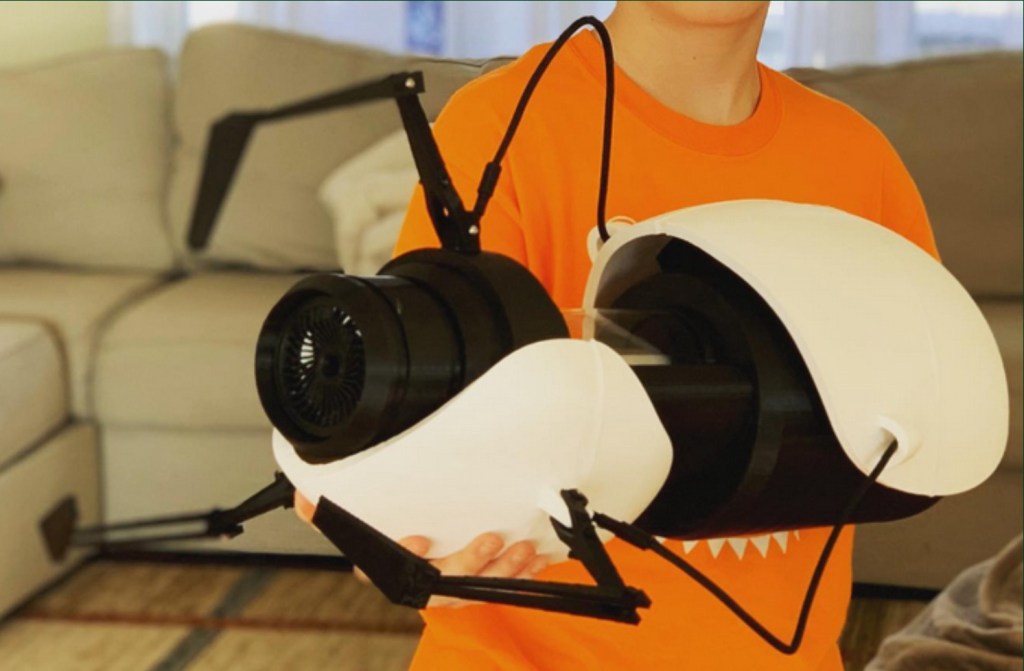
Until October 2024, it had been a few decades since something in formal school learning was so searingly relevant to and influential on my personal life. The last time, I lived with two Black women and learned from the education-related research of author Jonathan Kozol (1992) that these, two of my closest and most important friends, had experienced legal racist discrimination throughout every single layer of the U.S. education system. Last week I learned that the two autistic males with whom I live today, the boy holding the Portal gun (2007) in the image above and the man who 3-D printed and built it for his birthday, have been more effectively taught by commercially successful video games than by the U.S. education system.
This learning has been possible because the games these two, among a legion of fellow players, love, have been written by not just video game developers, but thoughtfully intentional digital pedagogues (Gee & Price, 2021). As I was, reading Kozol in that sunny patch of grass on my undergrad university campus decades ago, so I am again entering the churn of discovering that, for those with whom I share the intimacy of those mostly unremarkable everyday moments that add up to our lives, the role of formal learning is not at all what I have always presumed it to be. Consequently, I am again questioning what this revelation means for me, for my not insubstantially self-defining role within formal learning. Can I continue to serve as an institution-keeper, knowing once again that to do so will be a betrayal of those I hold most dear? Or rather must I now, in light of this discovery, again submit myself to the process of being un- and re-made, transformed this time by sitting not at the feet of anti-racist thought leaders, but at those of none other than video game developers? I did not see this coming.
For almost exactly as long as my husband and son have been enjoying video games, I, a secondary English Educator, have been wringing my hands. I have not simply regarded video games as an inferior source of learning experiences. On the contrary, I have seen them as an aggressive detriment to such experiences, luring the attention of young minds away from the potential enrichment of “real” education in a calculated play for their addiction, as candy marketers would strive to convince us to replace the essential nutrients of whole foods with cavity-causing sugar.
Then, a few weeks ago, as our family watched a popular show set in the 1980s depicting middle schoolers enjoying the role-play game Dungeons and Dragons, a character on the screen referred to their medieval group of adventurers as a party. Immediately, I paused the show to clarify that the dialog was using a somewhat archaic definition of the word rather than the synonym for celebration. Before I could get the words out, however, my son defined the word exactly as I would have. Asking where he’d learned this usage, I found myself needing to investigate Super Mario Party (2018), at which point I learned that video games facilitate vocabulary acquisition at least as effectively as did my having bravely led many a party of students on an educational policy imposed slog–I mean, exciting quest–through many a vocabulary-building workbook. How many words, devoid of the potent motivation-inspiring power of situated sociocultural context, had I dumped through my students’ attention over the years, sifted right back out of their minds like sand through fingers? As have so many school teachers, I have “focused on content learning that does not correlate with problem-solving abilities” (p. 36) and the consequence has been a lot of wasted time–not just my own, but more tragically, my former students’ (Gee & Price, 2021, p. 36).
Researching my son’s source of language instruction–and fun–was also when I learned that there are video games designed to be played simultaneously by multiple people, each contributing complementary strengths. Mere hours earlier, within the accredited context of my own graduate studies, I had been exploring the social learning theories that define this very phenomenon. So a few weeks later, when game-design teaching and learner approach was characterized by Gee and Price (2021) as being used by “designers rarely today go[ing] their own way, but,” rather working, “on collectively intelligent teams,” (p. 36) I recognized these intellectual laborers as what they truly are: professional learning communities.
For the first time in a long time, I have a profound and detailed sense of my own ignorance and far more questions and answers. Reading over the list of best principles and practices by both curriculum and game designers, from “performance before competence” (36) and frequent, actionable feedback to “failure as a form of learning,” (36) and the need to continuously blur the line between formative and summative assessment, I am humbled (Gee & Price, 2021, p. 36). How would I begin to define performance in a lesson plan while eschewing competence? How do I create the kind of classroom culture wherein failure is genuinely celebrated as a toehold in the climb of learning new content? Most intimidating, how does an English teacher of 175ish students provide constant, actionable feedback on the skills that comprise essay writing? In two short weeks, I have lost much of my cognitive equilibrium, having had it replaced by what feels like a dire need for accommodation and equilibration (Zhiqing, 2015).
References
- Gee, J. P., & Price, A. (2021). Game-design teaching and learning. Strategies, 34(3), pp. 35-38.
- Kozol, J. (1992). Savage inequalities: children in America’s schools. Harper Perennial.
- NDcube. (2018). Super Mario Party (US Version). Nintendo Switch.
- Valve. (2007). Portal. Windows & Xbox360.
- Zhiqing Z.. (2015). Assimilation, accommodation, and equilibration: A schema-based perspective on translation as process and as product. International Forum of Teaching and Studies, 11(1/2), pp.84-89.



 small Matters Learning
Leave a comment